
Consulting for the Kingdom
When the Treasury Department became too suffocating for Bruce Morgan in Saudi Arabia, he set out to create his own consulting firm to help the oil-rich country

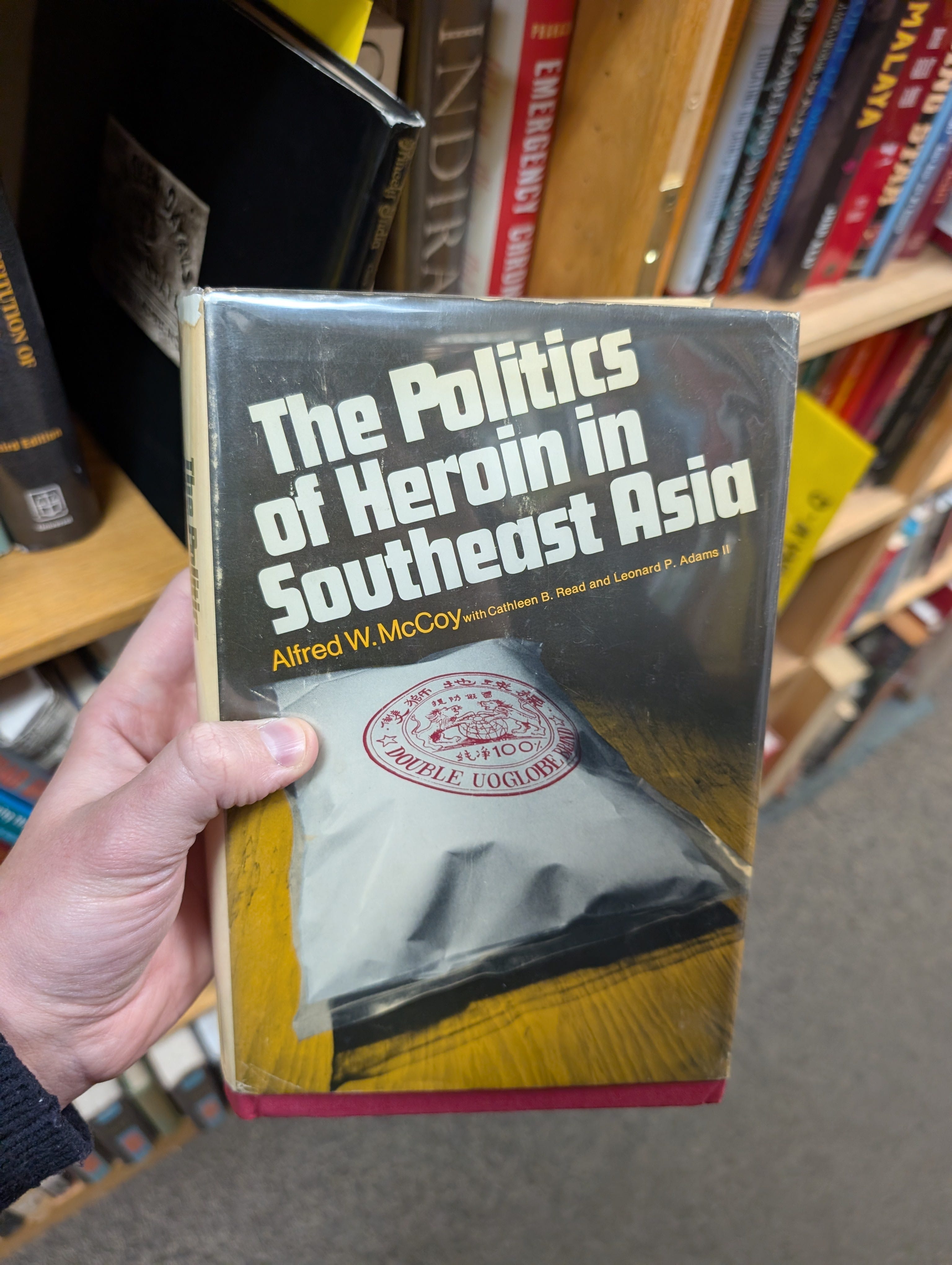
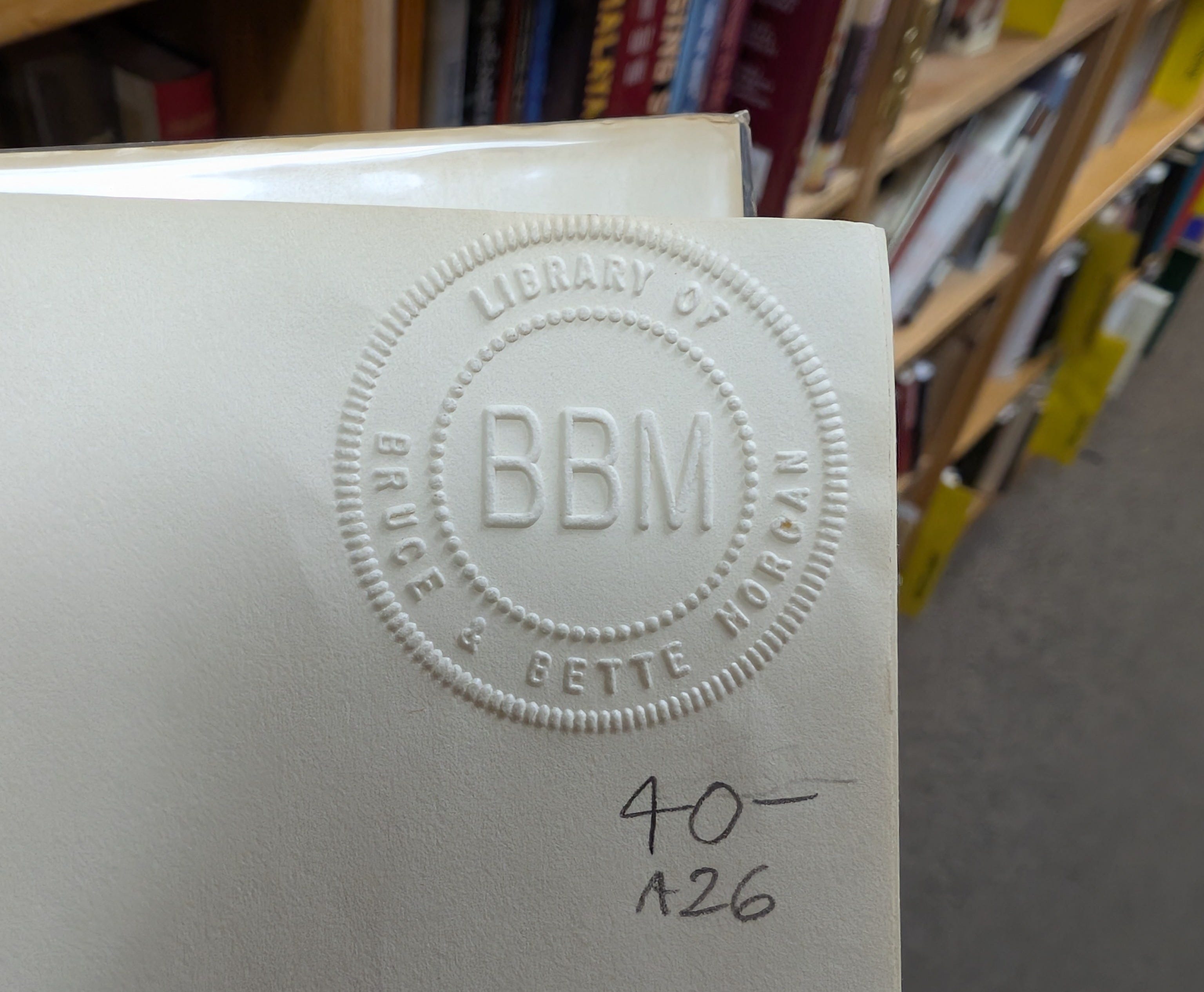
A couple weekends ago, I was browsing Second Story Books in Dupont Circle (one of my favorite local bookstores) when I came across a copy of Alfred McCoy’s The Politics of Heroin in Southeast Asia.1 Inside, on the upper right corner of the flyleaf, was an embossing that read “Library of Bruce & Bette Morgan”. As is often my wont when I come across an inscription in a book, I searched their names online and found that they had been residents of Washington, D.C., and that Bruce had passed in 2007. Of particular interest to me was Bruce’s Arlington connection, which I endeavored to investigate further. This article is the culmination of that investigation.
Bruce the Globetrotter
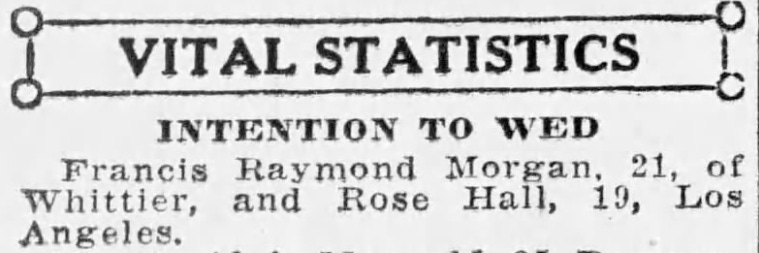
Bruce Raymond Morgan was born October 28, 1932, in Los Angeles to parents Francis Raymond “Jack” Morgan and Rose Hall Morgan (née Black) who married at 21 and 19, respectively. According to an obituary for Rose, Jack landed a job with the New Deal’s Works Progress Administration in Sacramento while Rose took care of their two children at home on 417 41st Street. When World War II rolled around, Jack was 35 and too old for the draft, but he nevertheless volunteered for the Marine Corps.
Young Bruce Morgan spent the first two decades of his life in southern California, attending Sacramento Junior College from 1950 to 1952 and then matriculating to the University of California-Berkeley. In 1957, Morgan graduated with an LLB and put his new degree to use, serving as a staff judge advocate with the U.S. Air Force in Dhahran, Saudi Arabia and later Casablanca, Morocco. This first posting to Saudi Arabia would prove to be the start of a long and fruitful relationship between Morgan and the Kingdom.
In the meantime, Morgan returned to California and spent some years in private practice at the firm Thelen, Marrin, Johnson & Bridges. By 1967, however, the wider world began calling again and Morgan left to serve with the Peace Corps in Kathmandu, Nepal, where he became close with Ambassador Carol Laise and his future business partner, William Newman. Then he was back in the States in 1971 for a stint at a Denver nonprofit focused on cross-cultural education.
In 1975, Morgan returned (briefly) to government service to lead the U.S. representation to the new Joint Economic Commission in Riyadh (JECOR). However, according to an interview with retired Ambassador Edward W. Gnehm, Jr., Morgan had a “falling out” with the U.S. Treasury Department, which wanted to manage Morgan more closely than he was comfortable with. Thus, after a mere six months, he ended his tenure as director and returned home.2
Shilling for the Saudis
In 1976, Morgan and William Newman incorporated consulting firm Morgan-Newman Associates, Inc., in the District of Columbia. Newman’s professional career closely paralleled that of Morgan: both worked for the Peace Corps in Nepal in the late 1960s, the Denver nonprofit in the early 1970s, and briefly for JECOR.
According to a spreadsheet of filings with the Foreign Agents Registration Act (FARA) Unit of the Department of Justice, Morgan-Newman first set up shop at 1629 K Street NW, Suite 700, in Washington, D.C.3 While the spreadsheet does not indicate the reason for the filing, a 1978 Penthouse article does. According to investigative journalist Craig S. Karpel’s “The Petro Industrial Complex” (“Big American business profits from high Arab oil prices—we lose.”):
Morgan-Newman Associates in Washington does consulting work for the Saudi Arabian Ministry of Finance and National Economy. The principals in the firm are both former Peace Corps officials who are applying their experience in helping the poor to helping the rich.
A history of the company from some years later expands on this:
During the mid 1970s, Saudi ministries and agencies were besieged by foreign governments and multinational companies with project ideas to help the Saudis spend their money, a huge petro-dollar surplus having been created by the trebling of crude oil prices in 1974. The Saudi Government had few sources for trusted consultant help, and when my later-partner, Will Newman, and I left the U.S.-Saudi Joint Economic Commission, we thought that we might act as go-betweens for Saudi clients needing technical expertise from individual consultants and mid-sized U.S. companies that could not, on their own, understand or afford the Klondike-like atmosphere of the Kingdom at that time.
One of Morgan-Newman’s biggest clients was the Saudi Basic Industries Corporation (SABIC), a petrochemical company established by the Saudi Minister of Industry and Energy in 1976.
Morgan-Newman’s New Move
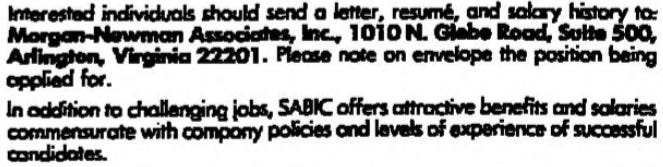
In 1984, Morgan-Newman left 1629 K Street and moved west to 2121 Foggy Bottom. In 1987, they moved yet again, this time across the river and into a fifth floor office at 1010 North Glebe. One year later, Newman left the company, which dropped the “Newman” and became Bruce Morgan Associates (BMA), Inc.4
Morgan’s new digs in Arlington were part of a relatively new development in an area trending toward taller and more expensive structures. In 1982, Oliver T. Carr of the Oliver T. Carr Company announced plans to build a $150 million office-retail-residential complex on the western side of North Glebe Road between Fairfax Drive and Washington Boulevard.5 Carr’s partner in this venture was CSX Minerals, Inc., a subsidiary of railroad giant CSX Corporation and the owner of the land Carr wanted to develop.
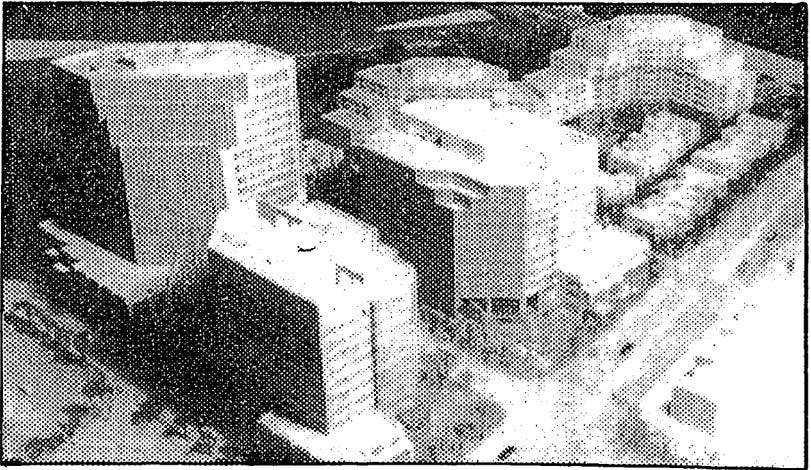
The land was originally part of the Lacey Estate, named for Civil War veteran and Arlington civic leader Robert Stinson Lacey, and property belonging to the now-defunct Washington & Old Dominion Railroad.6 In 1981, the Western Pocahontas Corporation, a merger between CSX Minerals and Eastern Pocahontas Corporation, acquired the land. Western Pocahontas subsequently changed its name back to CSX Minerals, and in 1983, CSX Minerals sold the land to Glebe Road Associates, another CSX Corporation subsidiary.7
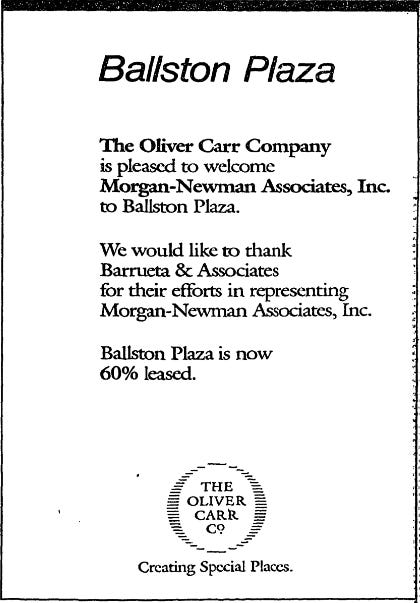
In August 1984, the Arlington County Board approved a site plan amendment request from Glebe Road Associates to alter the square footage of what would become Ballston Plaza (not to be confused with Ballston Corporate Center on the east side of North Glebe). Construction, which began soon after, was completed in 1987 and Carr began advertising rental space in The Washington Post.
BMA Inc. Enters the Future
In the waning years of the twentieth century, BMA Inc. began adapting to the new digital age and the Internet Revolution sweeping the country. According to GitHub user Max Hawkins and an archived list of domain names from the Defense Data Network’s Network Information Center, BMA Inc. registered the domain bmainc.com on June 21, 1994 with Patrick Little (postmaster@bmainc.com) as the administrator.8
In 1992, BMA Inc. established a subsidiary under Robert Stewart called Rapid Access International as a “quick turnaround information service” with a “direct link to…worldwide information resources” and a focus on East Asia. In 1998, Stewart made Rapid Access an independent company and moved it down the road to 1110 North Glebe. Also in 1998, the U.S. Navy’s National Shipbuilding Research Program highlighted BMA Inc.’s Electronic Commerce Monitor as a “useful publication” in its report “Define the Impact of Foreign ‘Metric’ Ships on Material and Inventory Control in U.S. Shipyards.”9
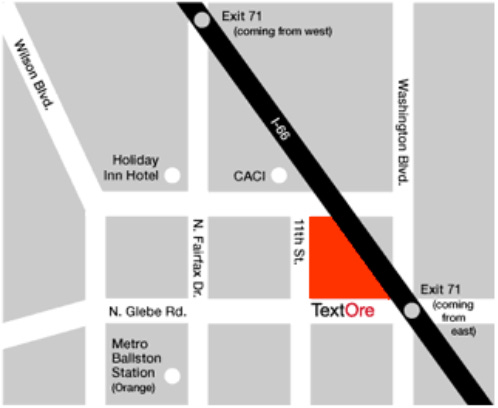
In 2000, Stewart’s Rapid Access collaborated with defense contractor Litton/TASC to develop TextOre, Inc., a text mining application. According to a 2003 Washington Post article, TextOre’s software “sweeps through documents, including patent filings, doctoral dissertations, e-mails and memos, looking for specific topics and then organizing the results in a simple grid.” One of TextOre’s biggest clients was Northrop Grumman, which acquired Litton/TASC the same year.10
Around the same time Stewart launched TextOre, Morgan began publishing “A newsletter on executive decision-making; from intuition to IT” as a “personal sabbatical after 25 years of running Bruce Morgan associates.” Morgan’s newsletter was a result of his belief that advancements in IT were not yet directly useful to senior management and policy makers, but would grow to be more useful in the coming years.
In early 2000, Morgan wiped bmainc.com and left behind the message
UNDER CONSTRUCTION
To be relaunched in April
When “construction” was finished, the website indicated that Morgan had moved his office back across the river and into his home at 3014 New Mexico Avenue NW. The BMA staff had disappeared and Morgan was offering research requests “as necessary”. Morgan was in his final years at this point and as noted above, he died not long after. He was 74.
Post-Script
To those of you that made it to the end, I want to thank you for indulging me with this article. I realize it is a little bit different from my usual Substacks about restaurants and bars. But I wanted to try something new, something that told a story about a person but also about Arlington and the way defense, lobbying, and consulting all intersect here, for better or for worse. I hope you enjoyed it and thanks as always for reading!
Harper & Row, McCoy’s publisher, turned over advance proofs of his book to the CIA, which McCoy accused of, at the very least, turning a blind eye to the heroin trafficking activities of its anticommunist allies in Southeast Asia. The CIA claimed to only want to review the proofs to ensure McCoy had the facts straight, but the episode became a First Amendment conflagration. See “Alfred McCoy Interviewed”.
For more information on Morgan’s work for JECOR, see The SABIC Story: Twenty-five Years of Achievement 1976-2001, pages 37 & 57, here.
The Foreign Agents Registration Act, enacted in 1938, requires individuals advocating on behalf of a foreign entity to periodically register their affiliation with the Department of Justice. See “Foreign Agents Registration Act (FARA): An Overview”.
According to his LinkedIn account, Newman took a professional hiatus from 1988 to 1991 before returning to work for the Peace Corps.
Readers will recall that the Oliver T. Carr company was responsible for the development that ousted Super Garden Market. See “From Corner Store to Corporate Gym Bore”.
The archived list was compiled by R. Scott Perry, an information technology specialist who authored The Modem Dictionary in 1994 and founded email security company Declude in 1997.
I could not find any additional information on the Electronic Commerce Monitor beyond its endorsement by the Navy.
TextOre still exists today with Stewart as CEO. Patrick Little, the original website administrator for bmainc.com back in the mid-1990s, is now the Chief Operating Officer for TextOre.