
Skyscraper Steakhouse
A German-American entrepreneur brought teppanyaki-style steak to America, growing his chain to 15 restaurants, including one in Rosslyn's Berkeley Building

Hello readers! Here for your enjoyment is another entry in The Matchbook Series, this one courtesy of Lisa’s Finders Keepers in Fredericksburg, VA.1 The store is full of really neat odds and ends and vintage items and I highly recommend checking it out if you’re ever in the area.
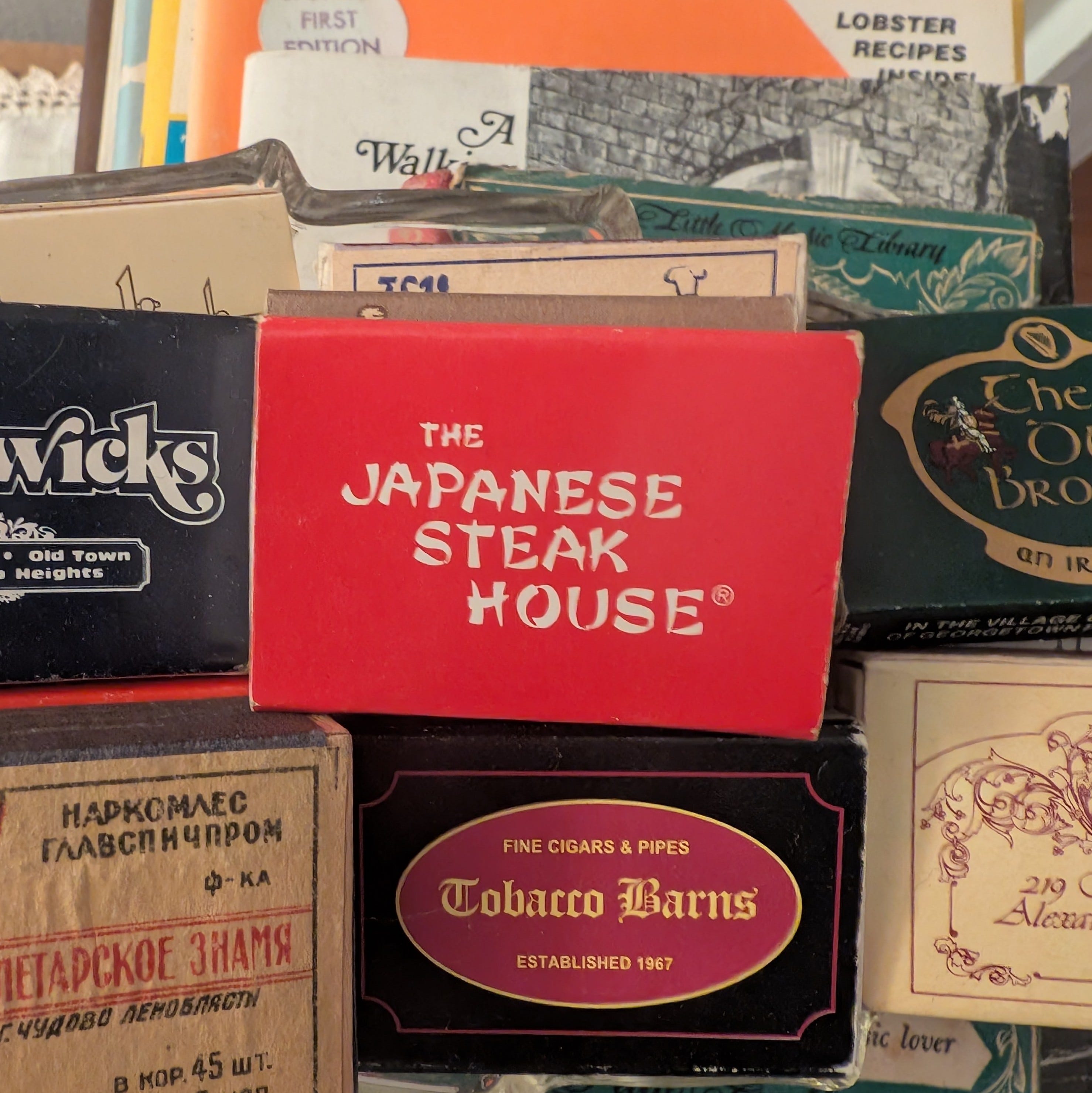
The matchbook—or, more accurately, matchbox—in question this time comes from The Japanese Steak House. While it once maintained two locations in the Washington, D.C.-metro area, as you can already guess, the focus will be on the Arlington location.
Japanese with German Characteristics
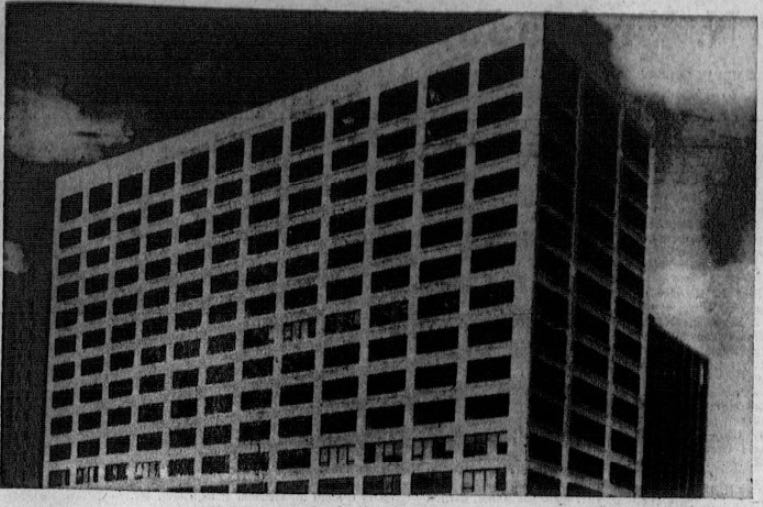
In September 1967, the Arlington County Board approved a site plan for a 12-story office building in Rosslyn on lots owned by D.C.-based mortgage bank Frederick W. Berens, Inc., and in 1968, construction began on the Berkeley Building at 1701 North Fort Myer Drive. At the helm were William Brakefield and Stanley Westreich, “prominent Rosslyn area builders and developers” and principals in the firm B.W. Associates, Inc.2 Some of their early tenants included the Northrop Corporation (predecessor to defense contracting giant Northrop Grumman), UNIVAC, Computer Response Corporation, and The Japanese Steak House.
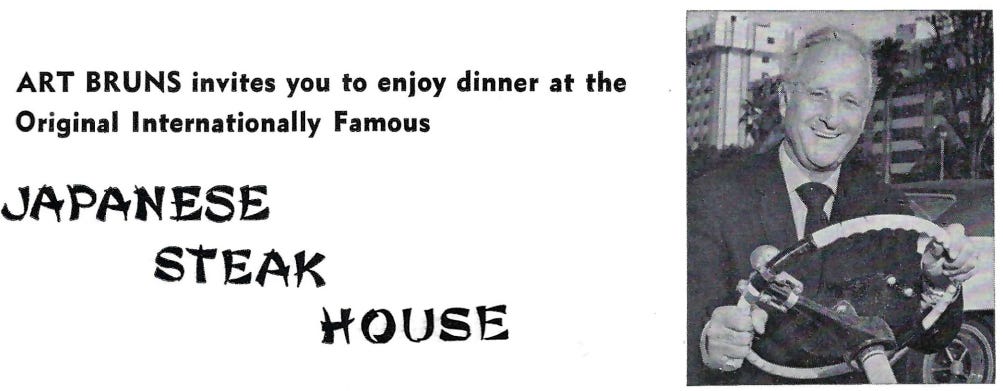
The Japanese Steak House did not begin in Arlington, however, but in perhaps the unlikeliest of places - Miami. In 1962, German-American (and Floridian) Arthur Gerhard Bruns, owner of the Miami Springs Villas, opened his first The Japanese Steak House, a teppanyaki-style steakhouse.34 Bruns was inspired after a visit to Japan and brought the idea of “steaks…prepared on a huge stone before your eyes” back to the States. According to the April 1963 issue of the Journal of the American Institute of Architects, Bruns’ Miami restaurant was one of only three in the world where steaks were prepared that way.5
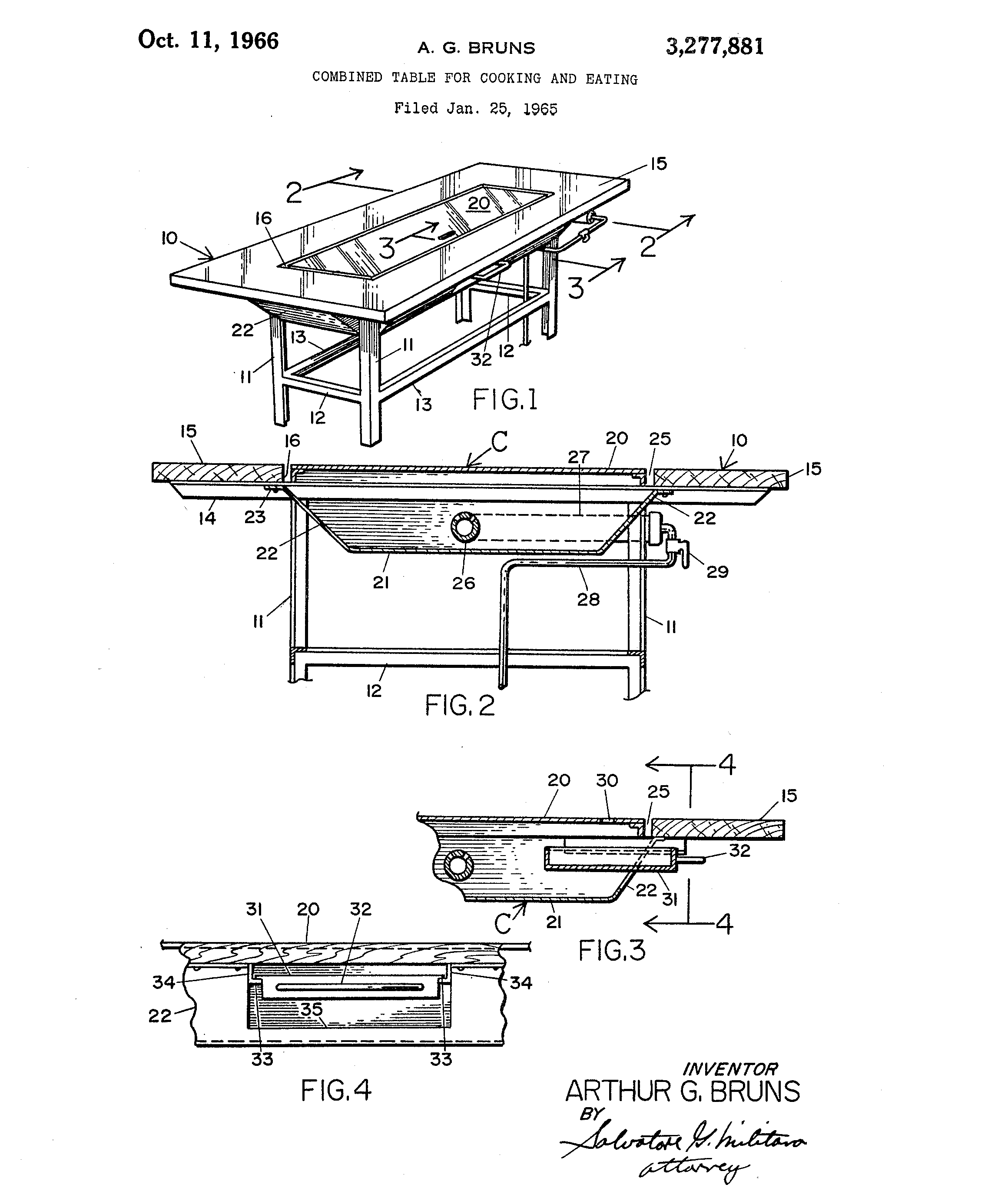
In addition to being a restaurateur and property developer, Bruns also dabbled in inventing. In 1965, he filed a patent application for a “combined table for cooking and eating…without subjecting the persons that are eating at the table to the intense heat being utilized for cooking purposes.” Bruns envisioned a table whose central portion would be dedicated to cooking with people (i.e., diners) seated about the outer portion. It is unclear how his invention differed, if at all, from a Japanese teppan.
The Melting Pot Grows
In 1971, Ah So Enterprises, Inc., trading as The Japanese Steak House and located at the lobby level of 1701 North Fort Myer, published a notice in the Northern Virginia Sun that they intended to apply to the state alcoholic beverage control board.6 Managing things at the Arlington location was Jim Tomko, a veteran of the Marriott Corporation whose ancestors hailed from Slovakia. According to Tomko, his Japanese vendors always added an extra “o” to his surname, assuming they were dealing with a fellow countryman named Tomoko. Tomko, who believed his vendors’ misplaced camaraderie was the reason behind their favorable prices, never corrected them.
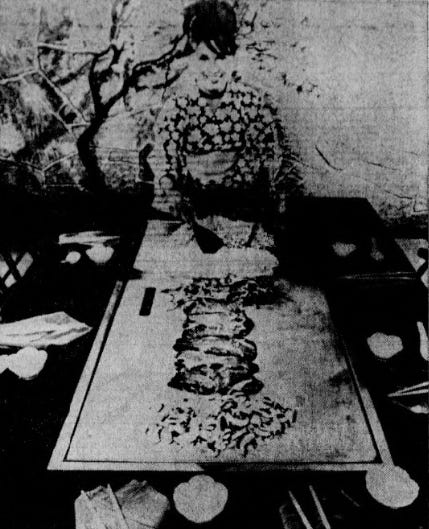
The Japanese Steak House opened on June 15, 1971, and was the fifteenth such location (but the first in Northern Virginia). It featured four different dining areas: the teppanyaki, of course, the Ah So cocktail lounge, “Oriental floor seating”, and “My Apartment”, which offered “intimate private tables with Hibachi cooking.” This last dining area was almost certainly a reference to the My Apartment restaurant at the Miami Spring Villas.
The Japanese Steak House enjoyed (mostly) good reviews during its first few years (see “A Steak House Decision”, “Fine Japanese Cooking at Steak House”, and “Family Out”) though Donald Dresden, a graduate of French cooking school Cordon Bleu, had some criticism for the restaurant:
Eating from the grill has its advocates, but plates…are more convenient than the awkward reaching for food on the grill with chopsticks or fork. Moreover, the lack of uniformity of grill heat can be bothersome. At a lunch in Rosslyn, my cubes of beef were cooked rare, but when piled in front of me they quickly became well done because the grill was so hot. But then at the same place at dinner, the grill was so cool that the steak and vegetables quickly cooled.
Combined with having to request soy sauce and his tea and rice arriving late, Dresden rated the Steak House a measly one-and-a-half “smiles”.7
What really put the Japanese Steak House on the map, however, was the opening of the Metro’s blue line in 1977. Tomko was able to time the Rosslyn lunch rush because of it:
You can tell because people come on schedule, in 10 or 15 minute intervals…[i]n fact, from the people lined up waiting to be seated…he can tell if the trains are running on time.
As Sandy Amann, a Northern Virginia Sun staff writer put it, the Rosslyn lunch rush came about for two reasons. The first was restaurant fatigue - white collar workers were tired of eating at the same restaurants day after day. The second, which alleviated the first, was the opening of the blue line. Lunchers now had a way to skip across town, try something new, and be back in time for the afternoon shift.
Those looking for a new lunch spot were not the only ones paying attention to the Steak House’s explosion in popularity, which grew so much that 1701 came to be referred to as “the Japanese Steak House building.” In 1982, the Chief of the CIA’s Executive and Planning Staff sent a memo to the Acting Director of the Foreign Broadcast Information Service titled “Space Options Outside Key Building”.8 After explaining the merits of several different buildings, such as the Ames Building (1820 Wilson), the Chief expounded those of 1701:
Yet another option is the 4,100 square feet on one floor available at 1701 N. Fort Myer Drive (the Japanese Steak House building). As [redacted] investigation was informal, we do not yet have leasing cost figures on the space. The management of the building indicated the space was available now, but stressed it may not remain vacant for an extended period. While the building is privately owned, the Department of State has offices in it occupying three floors, with some of the elevators running only to those floors. I presume we could have a similar arrangement, perhaps piggybacking with State on existing protective service.9
Sayonara Steak House
As is often the case when writing articles about older restaurants, I could not find an exact closing date for The Japanese Steak House. However, there are some indicators of its downturn. In October 1991, the Rappahannock News reported that Ah So Enterprises was delinquent $504.82 in personal property taxes (presumably there was a Japanese Steak House in Rappahannock County). In 1992, Ah So Enterprises, Inc., a Florida corporation, was administratively dissolved. In 2001, Tomko advertised that he was looking for a restaurant cook for the IHOP on North Stafford Street. And in 2006, a separate Florida corporation called Ah So Japanese Restaurant, Inc., was voluntarily dissolved. Thus, while an exact closure date is elusive, it can be safely said that by the early 2000s, The Japanese Steak House was no more, and it joined The Pawnshop Restaurant as another once-vibrant, since-closed, Rosslyn skyscraper lobby restaurant.
Thank you for reading! If you have an topic you’d like me to explore, please feel free to leave a comment or send me a message.
The previous entries in the series are “Gone to Seed, Then Came Reed”, “The Colonial Village Fiefdom” and “Pasta and Panorama on the Potomac”.
The name of the firm presumably derives from its principals’ surnames. Brakefield and Westreich, in partnership with Jared Drescher, also formed Westfield Realty. See “Stanley Westreich Obituary”.
In 1966, Brakefield and Westreich were indicted on conspiracy and perjury charges stemming from a case involving Arlington Towers tenants. See “Conspiracy Indictments Returned in Lease Case”.
Teppanyaki is a combination of teppan, meaning metal plate, and yaki, meaning grilled or pan-fried. See “The Art of Teppanyaki”.
See page 53, “Out on the Town in Miami”.
Per The Washington Post dining, restaurants are rated on food using a 0 to 4 “smiles” scale.
The Key Building is located at 1200 Wilson Boulevard in Rosslyn.